

Published: 18/09/2026
Australian Government Announces Migration Program Changes
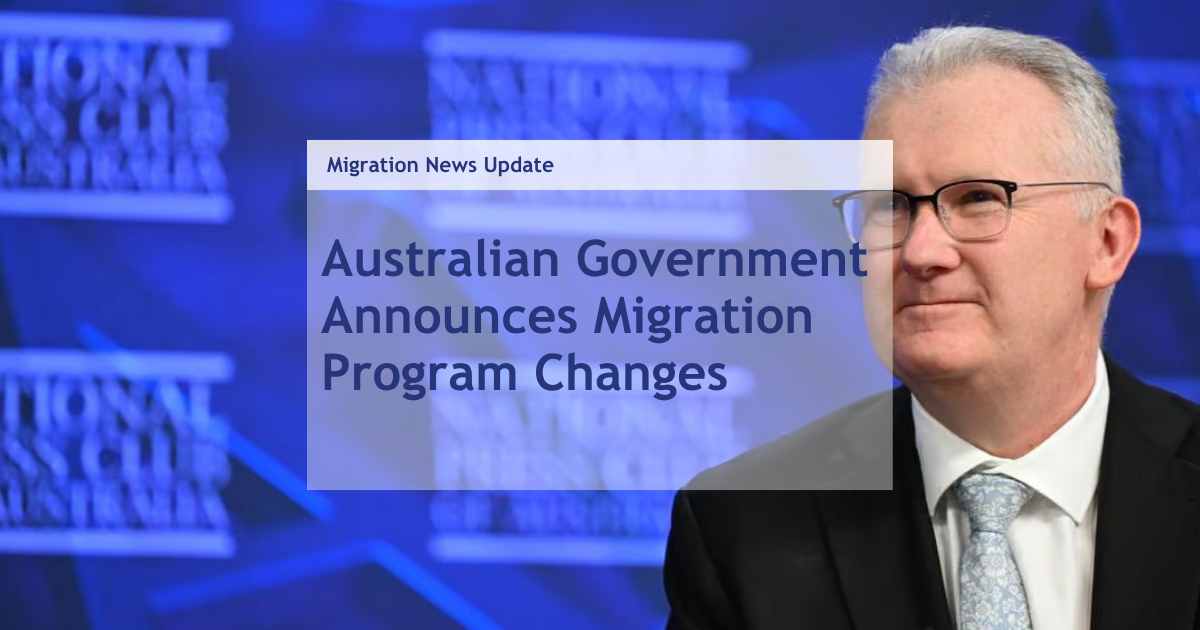
The Australian Government announced several changes to Australia’s migration program on 17 September 2026.
Home Affairs Minister Tony Burke said the changes aim to give the Government greater control over migration numbers, reduce inappropriate visa use, and prioritise skills needed within Australia.
The announcement covers student and graduate visas, visitor visas, Working Holiday Maker visas, skilled migration, visa overstayers, and migration agent conduct.
When will the changes take effect?
The changes did not all commence on 17 September 2026.
The Department of Home Affairs has confirmed that implementation has started. The measures will be progressively introduced over the next 12 months.
However, separate commencement dates have not been published for most measures. Further regulations, ministerial directions, policy guidance, and transitional arrangements are expected.
Until a particular change commences, the existing rules continue to apply. The effect on lodged applications and existing visa holders may also depend on future transitional arrangements.
Anyone planning an application should confirm the rules applying at the time of lodgement.
Net Overseas Migration
Australian Bureau of Statistics data released on 17 September showed that Net Overseas Migration was 292,100 for the year ending March 2026. This was down from 309,500 during the previous 12 months.
Australia’s population increased by 392,700 during the same period, reaching approximately 27.9 million.
The Government is forecasting Net Overseas Migration of:
- 245,000 during the 2026-27 financial year
- 225,000 during 2027-28
The Minister said the announced measures would support these forecasts without making broader reductions that could affect essential services and workforce needs.
Student and graduate visa family members
The Government intends to restrict secondary applicants on most Student and Temporary Graduate visas.
Under the announced policy, most future students and graduates will not be able to include partners or dependent family members in their visa arrangements.
The Minister confirmed that exceptions would apply to students from Pacific and ASEAN nations. Exceptions will also apply to certain courses, with PhD programs given as an example.
Complete eligibility details have not yet been released.
Families already attached to visas and living in Australia will not be separated by the changes. Further guidance is still needed for lodged applications, subsequent entrant applications, and families currently outside Australia.
Student visa extensions, transfers, and further study
The Government also plans to change how international students move between courses.
Genuine extensions will remain available where a student cannot complete their course within the expected period. Examples may include serious illness or the closure of an education provider.
Students transferring between courses would need to apply for a new student visa. This would allow the Department of Home Affairs to assess whether the transfer is genuine.
After completing a qualification, students would generally only be permitted to progress upwards through the qualification framework. For example, progressing from a bachelor degree to a master degree would remain possible.
Detailed rules covering packaged courses, qualification levels, course transfers, and current students have not yet been published.
Visitor visas and No Further Stay conditions
The Government intends to attach a No Further Stay condition to future visitor visa grants.
This would generally prevent a visitor from applying for another substantive visa while in Australia. Protection visa applications would remain outside the proposed restriction.
The Minister said the measure would apply to future visas and would not affect people already in Australia under existing arrangements.
The Government expects this change to support genuine visitor visa applications, including applications from partners waiting overseas for partner visa decisions.
The exact condition, commencement date, and any available exceptions or waiver arrangements remain to be confirmed.
Working Holiday Maker visa ballots
A ballot system will be introduced for second and third-year Working Holiday Maker visas where specified regional work requirements apply.
Applicants would still need to complete the existing work requirements before entering the ballot:
- 88 days of specified work for a second-year visa
- Six months of specified work for a third-year visa
Completing the required work would qualify an applicant to enter the ballot. It would no longer guarantee access to another Working Holiday Maker visa.
The proposed annual ballot limits are:
- 45,000 places for second-year visas
- 5,000 places for third-year visas
The Minister said approximately 57,000 people qualified for second-year visas last year. Approximately 31,000 qualified for third-year visas.
Different arrangements apply to UK passport holders under the Australia-United Kingdom Free Trade Agreement. UK applicants are not subject to the same specified work requirements.
The Government also intends to stabilise relevant Working Holiday Maker processing times at approximately three months.
Skilled migration changes
The Government has announced changes to both the skilled migration points test and visa processing priorities.
Under the revised points test, selected housing construction trades would receive the same number of points as a university qualification.
The final points structure, eligible occupations, and commencement date have not been released.
Ministerial Direction 119 will also be updated to support priority processing across key sectors, including:
- Healthcare
- Construction
- Education
- Law enforcement
- Defence
- Resources
- Agriculture
- Aquaculture
- Fishing
Some of these sectors already receive priority under the current direction. The updated direction is expected to expand and clarify the priority arrangements.
Compliance involving visa overstayers
The Government intends to increase compliance activity involving people who remain in Australia without a valid visa.
The announced measures include:
- 100 additional compliance officers
- 250 additional immigration detention beds
- Consideration of a former quarantine facility in Melbourne
The Minister described the approach as a return to compliance practices used before 2015. People without valid visas may be directed to leave and could face detention if they do not depart.
The Government said the measures are intended to encourage voluntary departure and maintain confidence in the visa system.
Migration agent conduct
The Government also plans to strengthen regulation of migration agents who knowingly support applications without merit.
Agents who encourage inappropriate applications may face additional sanctions or deregistration.
The Minister also discussed concerns about non-genuine protection visa claims. However, he confirmed that broader changes in this area would require legislation. No detailed legislative proposal was announced.
Character-related visa decisions
Ministerial Direction 110 will be updated to strengthen consideration of:
- Children who are victims of crime
- Victims of domestic and family violence
- Criminal conduct involving hatred
Further information will be available once the revised direction is published.
What should visa applicants do?
These announcements establish the Government’s intended direction. They do not mean every change is already operating.
Many important details remain outstanding, including commencement dates, transitional arrangements, exemptions, and the treatment of applications already lodged.
If you are unsure how the announcement may affect your current visa, family members, studies, future application, or migration plans, contact This is Australia Migration.
Our team can provide further information or specialised migration advice based on your individual circumstances.
This article contains general information only. It does not constitute migration or legal advice. Information is current as at 18 September 2026.
Official sources: Department of Home Affairs migration policy changes, Minister for Home Affairs media release, National Press Club address, and Australian Bureau of Statistics population data.
Call +61 (0)7 5592 0755
Or book an appointment with one of our registered migration agents .
Recent posts



Share this post:
We strive to keep abreast of the all the latest news and goings on in the complex world of migration. For regular updates and to be part of the community, don’t forget to like our Facebook Page.